
Shield of Childhood
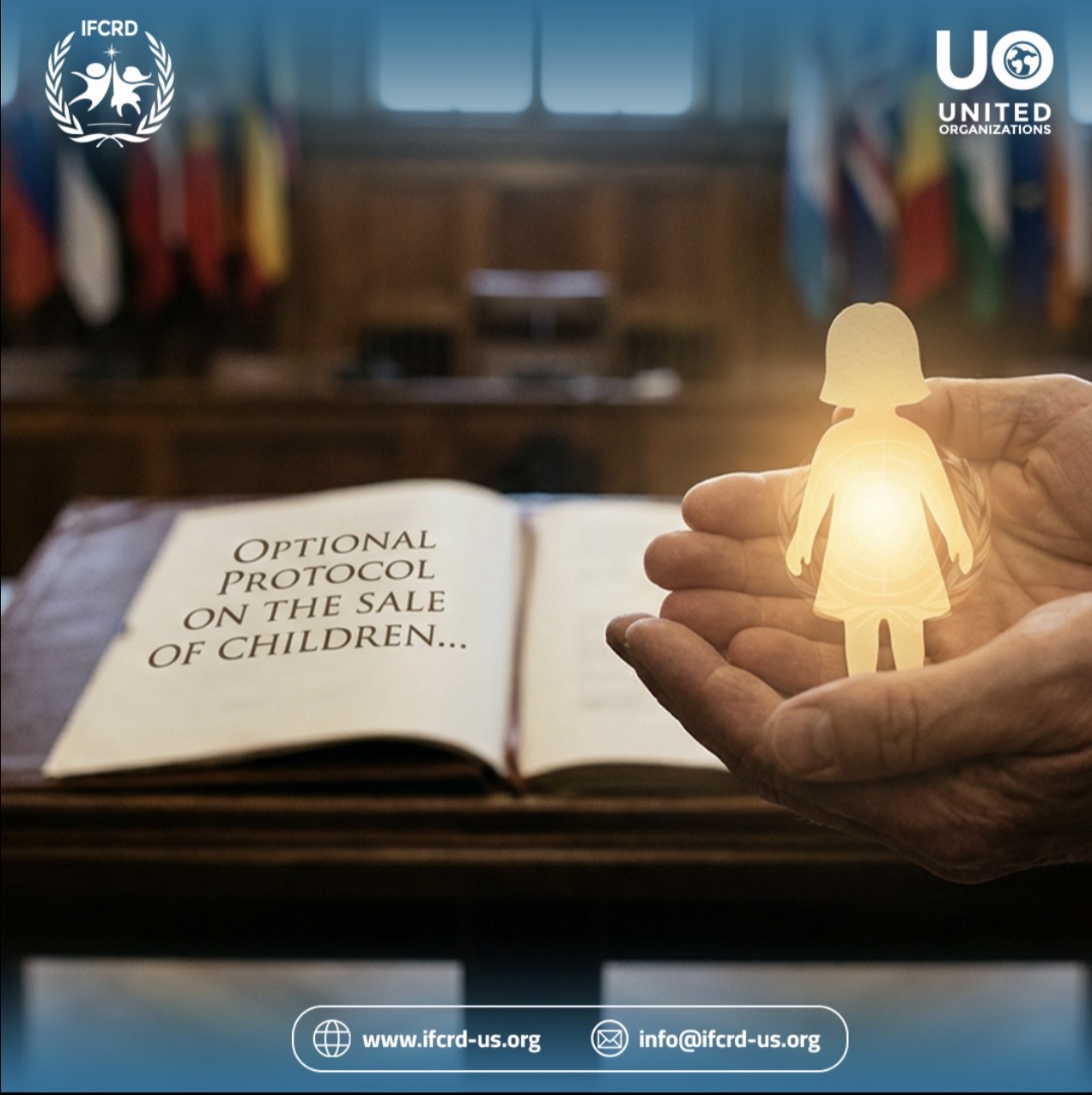
A Legal Reading of the Optional Protocol on the Prevention of the Exploitation of Children
In light of the growing challenges facing childhood at the global level, the Optional Protocol to the Convention on the Rights of the Child on the sale of children, child prostitution and child pornography emerges as one of the most important international legal instruments concerned with protecting children from the gravest forms of exploitation. This Protocol has contributed to providing a solid legal foundation for human rights organizations—foremost among them the International Federation for Child Rights and Defense (IFCRD)—to carry out their roles in accountability, protection, and the defense of children’s dignity.
First: Legal Context and Reference Framework
The United Nations General Assembly adopted this Protocol under Resolution No. 54/263 on 25 May 2000, as part of completing the international system for the protection of children’s rights. The Protocol was not merely a formal addition to the 1989 Convention on the Rights of the Child; rather, it came to fill existing gaps by providing precise legal definitions and imposing binding implementation mechanisms on ratifying states, whose number has reached 178 according to the latest United Nations data.
Second: States at the Forefront of Commitment (Examples of Ratifications)
The large number of States Parties reflects growing international awareness of the seriousness of crimes committed against children and the necessity of confronting them through legislation and judicial action. Among the most prominent countries that have become parties to this Protocol and are subject to monitoring by the Committee on the Rights of the Child are:
🔹 At the Arab level: Syria, Egypt, Morocco, Tunisia, Qatar, the United Arab Emirates, Jordan, Sudan, and Lebanon—states that have deposited their instruments of ratification, strengthening the legal framework for human rights work in the Arab region.
🔹 At the European level: France, Italy, Spain, Germany, and Norway, where national legislation has been harmonized with the provisions of the Protocol, particularly in combating the sexual exploitation of children in pornography, including via the Internet.
🔹 At the international level: Countries concerned include India, Canada, and Brazil, in addition to the United States of America, which has signed the Protocol but not ratified it, and is therefore not legally bound by its provisions.
Third: The Three Criminal Elements (Legal Characterization)
The Protocol obliges States Parties to criminalize three principal categories of offenses in their national legislation:
- Sale of children: Any transfer of a child for any purpose, including illegal adoption, forced labor, or organ transfer, in exchange for financial or other consideration.
- Child prostitution: The exploitation of a child in sexual activities, with explicit affirmation that any claim of the child’s consent is legally invalid due to lack of legal capacity.
- Child pornography: The production, distribution, or possession of materials depicting the sexual exploitation of children—an essential focus in confronting challenges posed by the digital space and modern technologies.
Fourth: The Role of the International Federation for Child Rights and Defense
The broad scope of States Parties to this Protocol provides the Federation with a clear legal basis to fulfill its role, particularly in:
• Monitoring and following up on periodic reports submitted by States Parties to the Committee on the Rights of the Child in Geneva.
• Advocating for legal accountability, especially in transnational crimes, in cooperation with relevant international mechanisms.
• Ensuring the protection of the privacy of child victims and preventing their re-victimization during judicial proceedings.
✨ The Federation’s Position
The wide international ratification of this Protocol does not represent mere numbers; rather, it constitutes a binding international legal commitment that enables the Federation to call upon governments to adopt effective measures ensuring a safe environment, preserved dignity, and genuine protection for every child.
The International Federation for Child Rights and Defense reaffirms its unwavering commitment to confronting all forms of child exploitation and to defending these principles without compromise.
References:
•United Nations, General Assembly. (2000). Optional Protocol to the Convention on the Rights of the Child on the sale of children, child prostitution and child pornography (Resolution 54/263, May 25, 2000).
•Committee on the Rights of the Child. (2011). General comment No. 13 (2011): The right of the child to freedom from all forms of violence. Geneva: United Nations.
•United Nations Treaty Collection. (2026). Status of ratification of the Optional Protocol to the Convention on the Rights of the Child on the sale of children, child prostitution and child pornography. United Nations Office of Legal Affairs.
•United Nations Office on Drugs and Crime. (2020). Handbook on combating online child exploitation and trafficking in children. Vienna: United Nations.